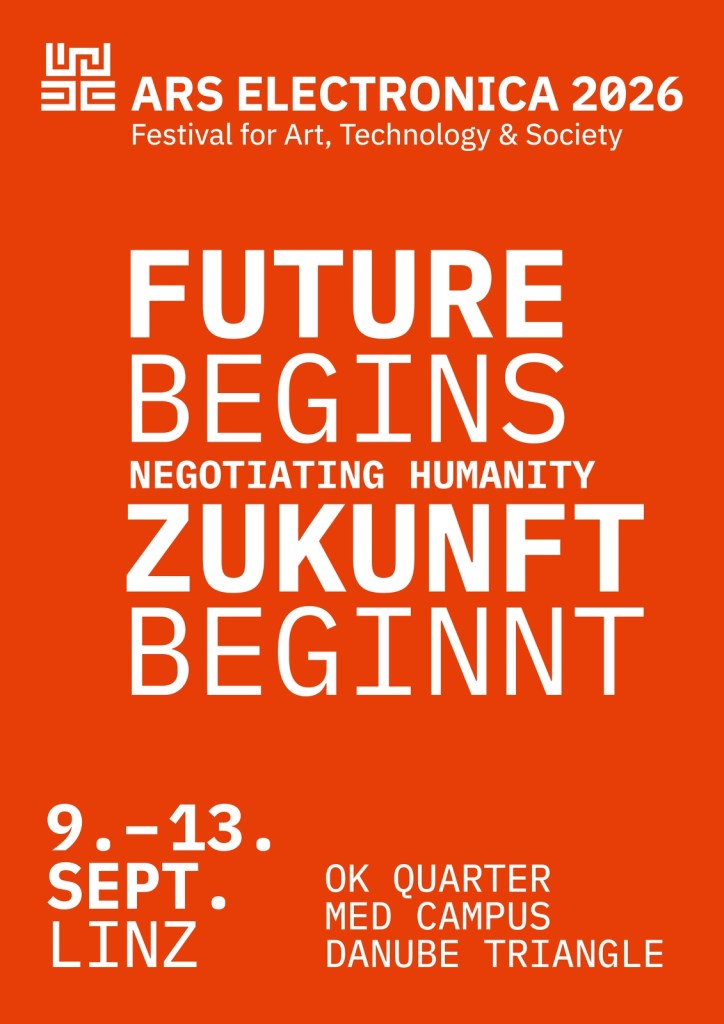
In 2026, Ars Electronica is dedicating itself to the theme “Future Begins.” The occasion is the 30th anniversary of the Ars Electronica Center, which represents much more than just a museum jubilee: In 1996, the Ars Electronica Center and the Ars Electronica Futurelab began operations and transformed Ars Electronica—which at the time comprised the festival, initiated in 1979, and the competition for CyberArts, launched in 1987—into a year-round ecosystem at the intersection of art, technology, and society.
Subsequently, lighthouse projects such as the flight simulator “Humphrey,” the net art and telerobotics project “Telegarden,” the mixed-reality installation “Gullivers World” and the virtual environment “CAVE,” which developed into the Deep Space in 2009 and has since been sold worldwide, were created. Also in 2009, Hiroshi Ishiguro’s android “Geminoid” was welcomed to Linz, followed by Honda’s humanoid robot “ASIMO” in 2010. In 2011, an exhibition was designed together with CERN. In the context of the Klangwolke (Cloud of Sound) in 2012, a swarm of 50 light drones illuminated the night sky over the Donaupark, and by November 2015 it was further developed into the world’s largest autonomous drone swarm together with Intel. Also in 2015, Daimler’s futuristic concept car “F015 Luxury in Motion” completed its first laps on European soil in Linz. In 2016, the Ars Electronica Center presented an exhibition in collaboration with the Tangible Media Group from MIT. In 2019, the installation “GPT-2: Sprachfelder,” developed with OpenAI, could be experienced at the Ars Electronica Center.
All of these artistically inspired experiments, research, and communication projects revolve around the accelerating technological development, its impact on our lives, and its potential to contribute to social progress. They were (and continue to be) possible only because the ecosystem of Ars Electronica was and is able to engage in creative exchange with all parts of society with the purpose of collaborating on future questions. A successful path that will be continued in 2026.
Future Begins…at the Ars Electronica Festival
One year after POSTCITY, the Ars Electronica Festival is reinventing itself. Instead of a single festival location, the five-day event will transform Linz’s city center into both a stage and a forum for art, technology, and society. Three major hubs and a series of additional venues will host events, and new formats will be developed. The festival will be dedicated to the annual theme “Future Begins,” while adding the subtitle “Negotiating Humanity.” At its core, this implies a status assessment and the question of what it means to be human nowadays .
Negotiating Humanity
Be it in politics, technology, culture, or ecology, we are standing at the threshold of a new era. We are witnessing the second Trump administration shatter the world order established after World War II, while we ourselves are trapped thinking in the stereotypes of hopelessly polarized societies. We watch in disbelief as tech giants and their investors pour astronomical sums into the development of AI models and the construction of data centers, uncertain of how fast and fundamental the resulting revolution—for example, in the labor market—will be. We have no idea how chatbots and AI agents will transform the internet—whether and how they will further accelerate the erosion of our shared reality and lead to even greater surveillance by omnipotent corporations. Finally, we are caught in the vortex of a worsening climate crisis that will not disappear simply because it is being pushed out of the headlines by the many other crises.
We are witnessing the old end, while not yet knowing what it will be replaced by. “The crisis consists precisely in the fact that the old is dying and the new cannot be born; in this interregnum a great variety of morbid symptoms appear.” These lines, written in 1930 by Marxist Antonio Gramsci in his diary while imprisoned by the Mussolini regime are uncannily timely. They remind us of the fact that moments like this one are decisive—moments in which the future has not yet been born, but the way it will look like depends on our present-day actions.
“Future is not a period in time, future is a realm of possibilities,” Gerfried Stocker wrote in his text for Ars Electronica 2026, which is dedicated to negotiating humanity. What does this mean? It means we must fight to shape technological development in a democratic, just, and humane way, instead of being guided by the logic of profit and platform power. It means preparing ourselves to live in a society permeated by technology, in which our self-worth and social status will no longer be derived from our work. It means taking the controversial thesis that AI systems will soon develop consciousness as an impetus to finally change the way we treat other species and nature.
“Negotiating Humanity” invites us to assess where we stand and asks what it means to be human in the 21st century—not to find and enforce the ultimate answer, but to cultivate the discourse that forms the very essence of our democratic coexistence. It is about assuming responsibility.
2026 verschreibt sich Ars Electronica dem Jahresthema „Zukunft beginnt“. Anlass ist das 30-Jahr-Jubiläum des Ars Electronica Center, das viel mehr als nur ein Museumsjubiläum ist: 1996 nehmen das Ars Electronica Center und das Ars Electronica Futurelab ihren Betrieb auf und verwandeln Ars Electronica – die bis dahin das 1979 initiierte Festival und den 1987 gestarteten Wettbewerb für CyberArts umfasst – in ein ganzjährig wirkendes Ökosystem an der Schnittstelle von Kunst, Technologie und Gesellschaft.
In der Folge entstehen Leuchtturm-Projekte wie der Flugsimulator „Humphrey“, das Netzkunst- und Telerobotik-Projekt „Telegarden“, die Mixed-Reality-Installation „Gullivers Welt“ und der Projektionsraum „CAVE“, der 2009 zum Deep Space weiterentwickelt und mittlerweile in alle Welt verkauft wird. Ebenfalls 2009 wird Hiroshi Ishiguros Android „Geminoid“, 2010 dann Hondas humanoider Roboter „ASIMO“ in Linz empfangen. 2011 gestaltet man eine Ausstellung mit dem CERN. Im Rahmen der Klangwolke 2012 illuminiert ein Schwarm von 50 Leuchtdrohnen den Nachthimmel über dem Donaupark, den das Ars Electronica Futurelab bis November 2015 mit Intel zum größten autonomen Drohnenschwarm der Welt weiterentwickelt. Ebenfalls 2015 dreht Daimlers futuristisches Concept Car „F015 Luxury in Motion“ seine ersten Runden auf europäischem Boden in Linz. 2016 zeigt das Ars Electronica Center eine Schau mit der Tangible Media Group des MIT. 2019 ist die mit OpenAI entwickelte Installation „GPT-2: Sprachfelder“ im Ars Electronica Center zu erleben.
All diese künstlerisch inspirierten Experimente, Forschungs- und Kommunikationsprojekte kreisen um die sich beschleunigende technologische Weiterentwicklung, ihre Auswirkungen auf unser Leben und ihr Potential, zum gesellschaftlichen Fortschritt beizutragen. Sie waren (und sind weiterhin) nur möglich, weil das Ökosystem Ars Electronica mit allen Gesellschaftsbereichen in einen kreativen Austausch treten kann, um Zukunftsfragen gemeinsam zu bearbeiten. Ein Erfolgsweg, der 2026 weitergegangen wird.
Zukunft beginnt … beim Ars Electronica Festival
In Jahr 1 nach der POSTCITY erfindet sich das Ars Electronica Festival neu. Anstelle einer zentralen Festivallocation wird der fünftägige Event die Linzer Innenstadt gleichermaßen zur Bühne und zum Forum für Kunst, Technologie und Gesellschaft machen. Drei große Hubs und eine Reihe weiterer Veranstaltungslocations werden bespielt und neue Formate entwickelt. Thematisch verschreibt sich das Festival dem Jahresschwerpunkt „Zukunft beginnt“, ergänzt diesen aber um den Untertitel „Negotiating Humanity“. Im Kern geht es um eine Standortbestimmung und die Frage, was es heute bedeutet, Mensch zu sein.
Negotiating Humanity
Ob Politik, Technologie, Kultur oder Ökologie – wir befinden uns an der Schwelle zu einer neuen Zeit. Wir sind Zeug*innen, wie die zweite Trump-Administration die nach dem Zweiten Weltkrieg errichtete Weltordnung zertrümmert und sind selbst gefangen im Lagerdenken heillos polarisierter Gesellschaften. Wir sind fassungslos angesichts der Unsummen, die Tech-Konzerne und ihre Investor*innen in die Entwicklung von KI-Modellen und den Bau von Rechenzentren investieren und unsicher, wie schnell und tiefgreifend die dadurch ausgelöste Revolution – etwa des Arbeitsmarktes – ausfallen wird. Wir haben keine Ahnung, wie Chatbots und KI-Agents das Internet verändern werden – ob und wie sie das Erodieren unserer geteilten Realität weiter beschleunigen und zu unserer noch stärkeren Überwachung durch allmächtige Konzerne führen werden. Zu guter Letzt befinden wir uns im Strudel einer sich verschlimmernden Klimakrise, die nicht verschwinden wird, nur weil andere Krisen sie aus den Schlagzeilen verdrängen.
Wir sehen, dass das Alte zu Ende geht, wissen aber noch nicht, was an seine Stelle treten wird. „The crisis consists precisely in the fact that the old is dying and the new cannot be born; in this interregnum a great variety of morbid symptoms appear.” Die Zeilen, die der vom Mussolini-Regime in den Kerker geworfene Marxist Antonio Gramsci 1930 in sein Tagebuch schreibt, sind unheimlich aktuell. Sie erinnern uns daran, dass Momente wie dieser entscheidend sind – Momente, in denen die Zukunft noch nicht geboren ist, wie sie aussehen wird aber davon abhängt, wie wir heute handeln.
„Zukunft ist kein Zeitraum, Zukunft ist ein Möglichkeitsraum“ formuliert Gerfried Stocker es in seinem Text zur Ars Electronica 2026, die sich der Neuverhandlung des Menschseins verschreibt. Was damit gemeint ist? Dass wir dafür kämpfen müssen, die technologische Entwicklung demokratisch, gerecht und menschenwürdig zu gestalten, statt von Profitlogik und Plattformmacht geleitet zu werden. Dass wir uns darauf vorbereiten, in einer von Technologie durchdrungenen Gesellschaft zu leben, in der unser Selbstwert und sozialer Status nicht länger von Arbeit abgeleitet wird. Dass wir die umstrittene These, KI-Systeme würden schon bald Bewusstsein entwickeln, zum Anlass nehmen, endlich unseren Umgang mit anderen Spezies und der Natur zu ändern.
„Negotiating Humanity“ lädt zur Standortbestimmung und fragt, was es im 21. Jahrhundert bedeutet, Mensch zu sein – nicht um die eine endgültige Antwort zu finden und durchzusetzen, sondern um jenen Diskurs zu pflegen, der die Essenz unseres demokratischen Miteinanders bildet. Es geht darum, Verantwortung zu übernehmen.
 J O R I T O K Y O
Voilà!
LikeLike